| Metric | WHEEL 1 | WHEEL 2 |
|---|
| Measurement | Wheel 1 | Wheel 2 | Diff |
|---|---|---|---|
| Diameter | — | — | — |
| Width (Tire) | — | — | — |
| Poke (Outer) | — | — | — |
| Inset (Inner) | — | — | — |
| Ride Height | — | — | — |
| Speedometer | — | — | — |
The Wheel & Tire Calculator is a free online tire size calculator that lets you compare two different wheel and tire combinations side by side. Enter your current setup as Wheel 1 (base) and your proposed new size as Wheel 2, and instantly see the full fitment data — no button click needed.
It calculates diameter, circumference, poke, inset, speedometer error, ride height change, arch gap change, and ideal rim range — everything you need to check before ordering new wheels or tires.
Checks if wheels fit inside your arches
Shows speedometer impact of size change
Side view & front view update live
Calculate suspension & arch gap change
Three simple steps to check your wheel and tire fitment, compare sizes, and calculate speedo error — all in one tool.
01
Step 1
Input your existing wheel diameter (inches), width (inches), and ET/offset (mm). Then enter your current tire width (mm) and profile percentage. This is your baseline for comparison.
02
Step 2
Enter the specs for the new wheel and tire combination you want to fit. The calculator will compare it against Wheel 1, showing diameter difference, poke, inset change, and speedometer error.
03
Step 3
Click Calculate to instantly see the side-view profile comparison, front-view offset/poke diagram, and a full metric table including speedo error at 30mph and 60mph.
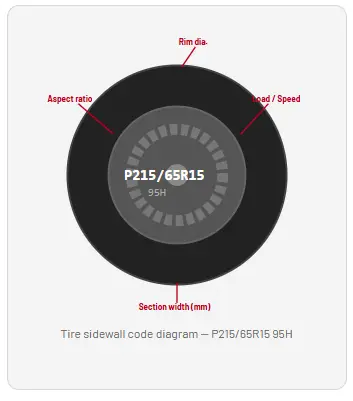
P215/ 65R15 95H
P
P = Passenger car. LT = Light Truck. ST = Special Trailer. T = Temporary (spare).
215
The tire's width from sidewall to sidewall in millimeters. This is the first number you enter in the tire size calculator.
65
The sidewall height as a percentage of the section width. 65 means the sidewall is 65% of 215mm = 139.75mm tall.
R15
R = Radial construction. 15 = the wheel/rim diameter in inches this tire fits.
95H
95 = load index (690 kg max per tire). H = speed rating (up to 130 mph / 210 km/h).
Understanding these terms will help you read your tire size calculator results correctly and make the right fitment decisions.
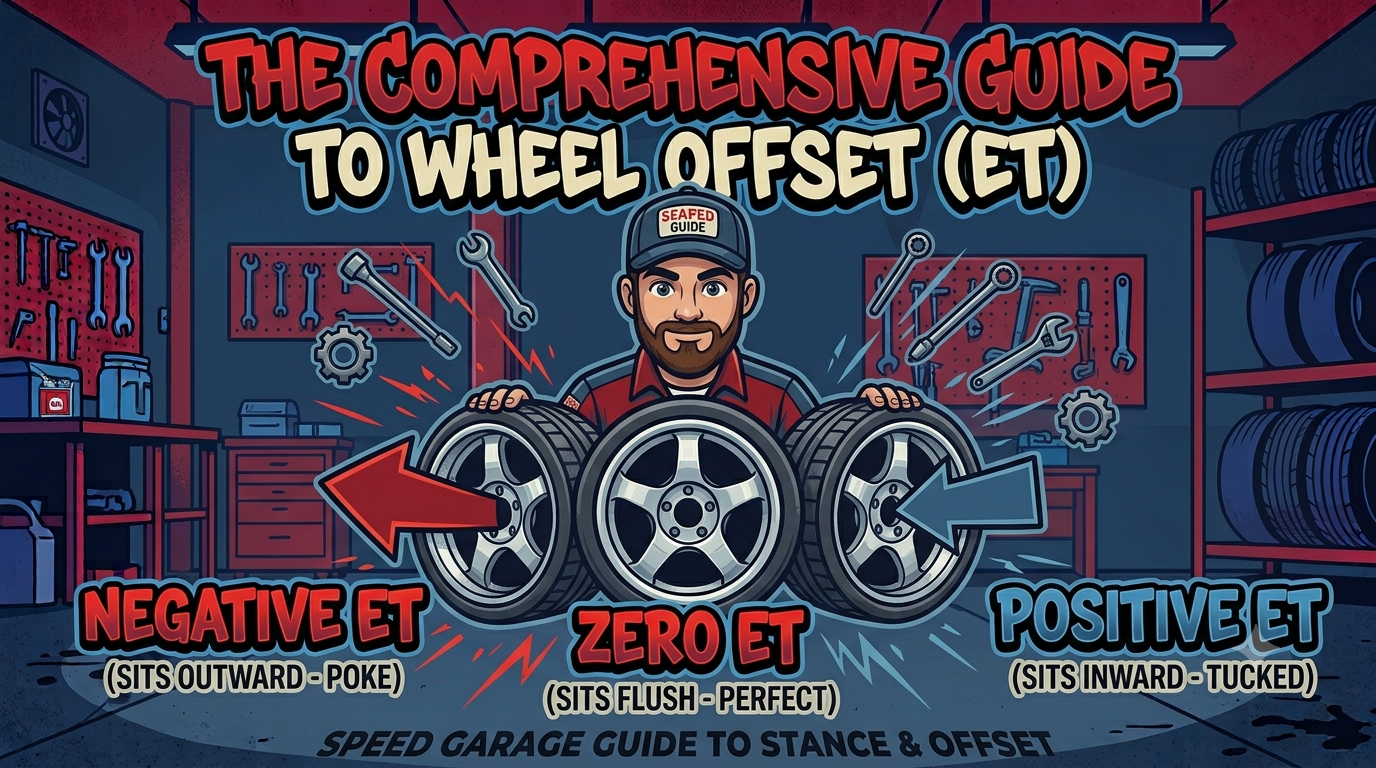
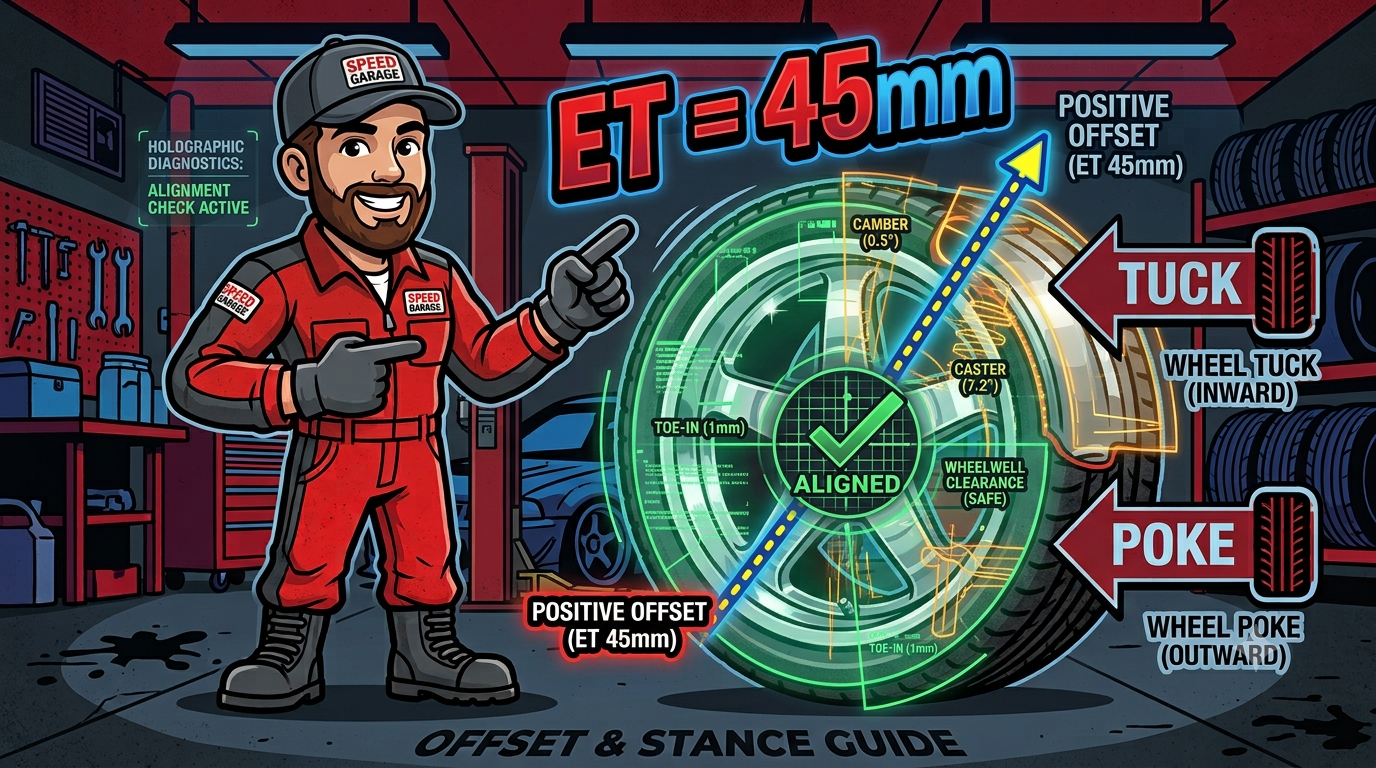
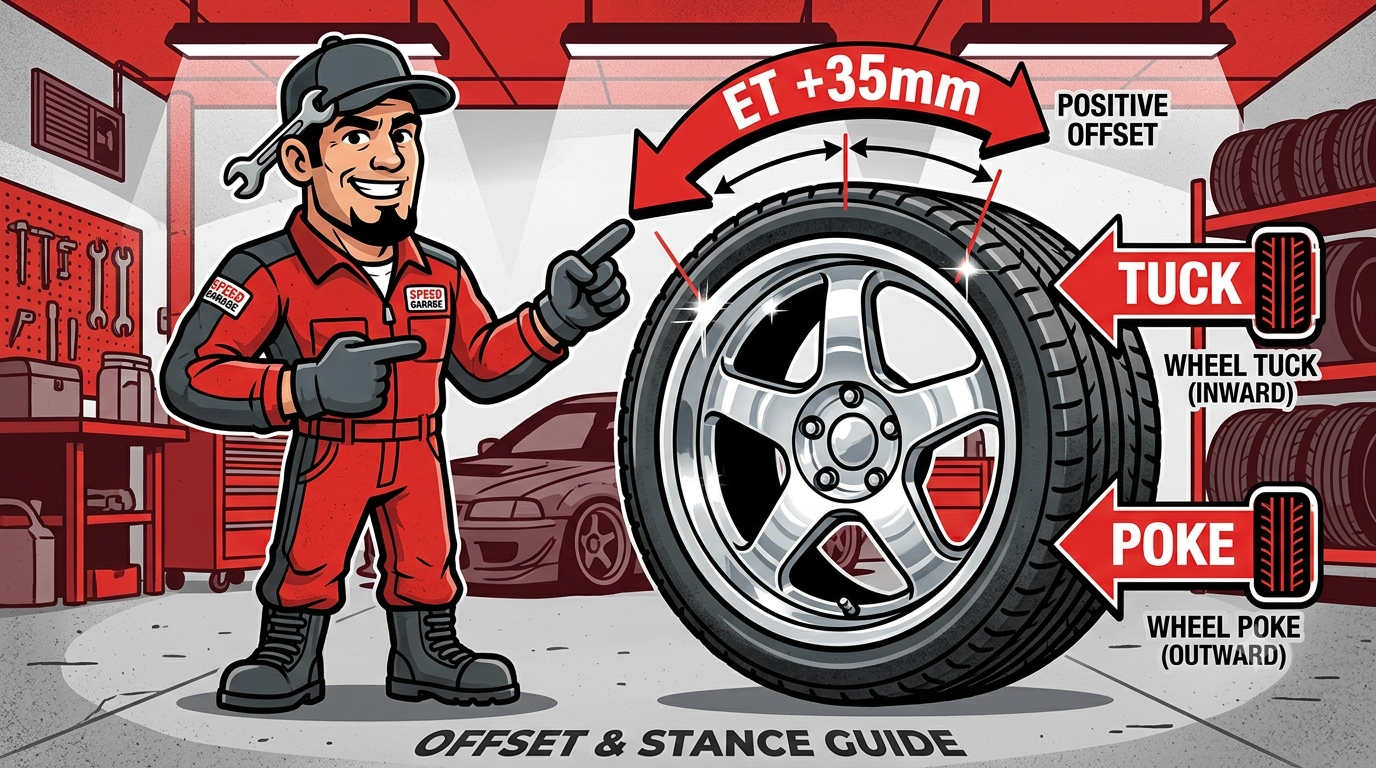
Einpress Tiefe — the distance in mm between the wheel's mounting face and its geometric centre. Positive ET = mounting face closer to the outside; Negative ET = closer to the inside.
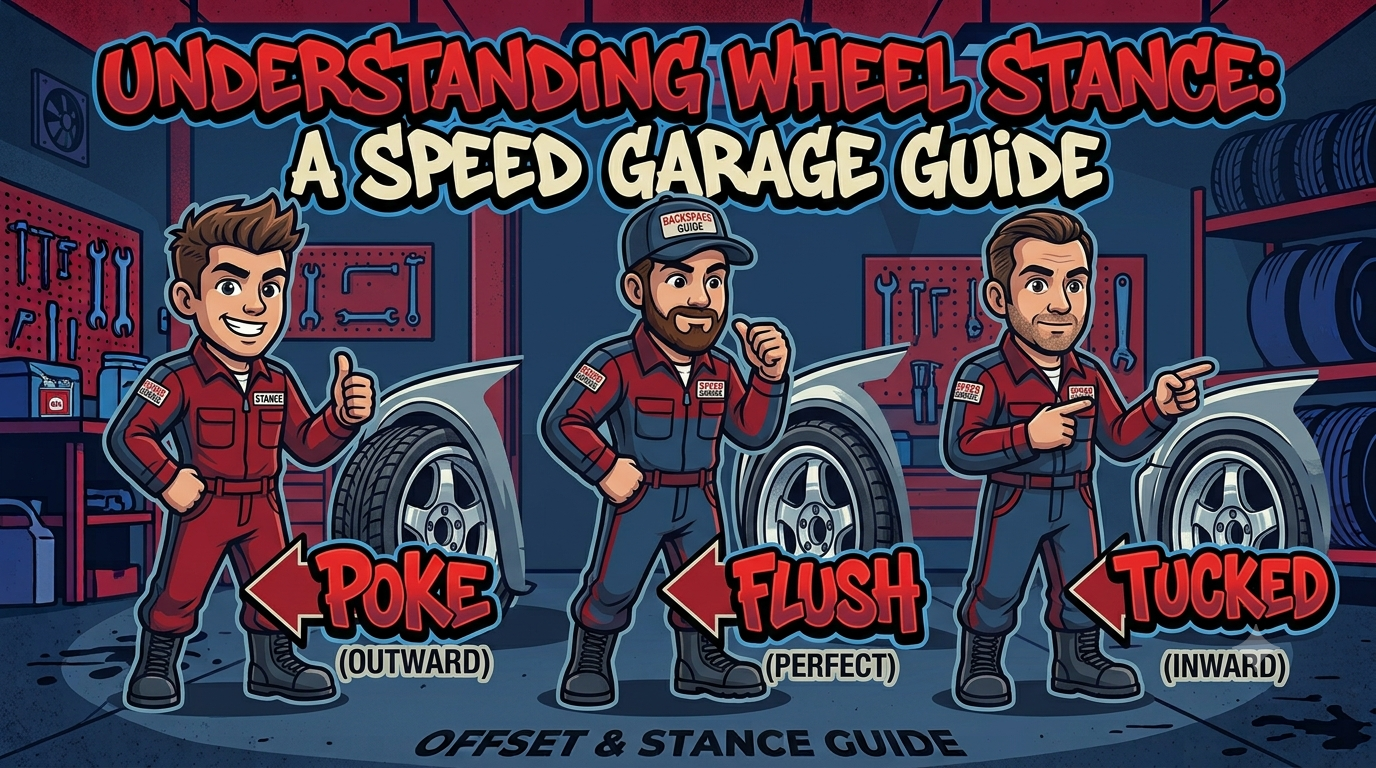
How far the outer edge of the tire sticks out from the wheel arch (fender). Positive poke means the tire protrudes outward. Excessive poke can cause rubbing on bodywork.
How far the inner edge of the tire sits from the suspension/strut. Larger inset values risk fouling the suspension or brake components on the inner side.
When you change tire size, your speedometer may read incorrectly because it measures wheel revolutions. A larger diameter tire covers more distance per revolution — the speedo reads low.
The ratio of a tire's sidewall height to its width, expressed as a percentage. A 205/45R17 tire has a sidewall height that is 45% of 205mm = 92.25mm.
Half the overall loaded tire diameter. Affects speedo accuracy and gearing. Changing rolling radius by more than 3% from OEM spec can affect ABS, traction control, and odometer readings.
Fitting a larger diameter rim with a lower-profile tire to maintain the same overall diameter. E.g. moving from 205/55R16 to 225/45R17 — same diameter, sportier look, sharper handling.
The distance from the wheel's inner mounting flange to the back of the wheel. Related to offset but measured differently. Critical for ensuring clearance behind the wheel.
The total width of the mounted and inflated tire from outer sidewall to inner sidewall, in mm. The first number in a standard tire code (e.g. 205 in 205/55R16).
Three critical fitment measurements you need to understand before changing wheel size or offset. Our wheel offset calculator shows all three instantly.
Poke (outer clearance) is how far your tire sticks out beyond the fender/arch lip. A small positive poke (flush or slightly proud) is the target look for most builds. Too much poke risks rubbing the arch liner. Our tire fitment calculator shows poke in mm for each wheel setup.
Inset (inner clearance) is the gap between the inner edge of your tire and the nearest suspension or brake component. Too little inset and your tires will foul the strut, caliper, or inner arch. Insufficient inset is a safety concern and cannot be fixed with spacers alone.
Rubbing happens when poke is too high (outer rub at arch) or inset is too low (inner rub at strut). Always check both values before buying new wheels. Low-profile tires rub less on bumps; wider tires are more susceptible. Our wheel and tire calculator flags these issues automatically.
Changing your tire size directly affects your speedometer accuracy. Here’s how to calculate speedo error and what it means for your vehicle.
Your speedometer works by counting the number of wheel revolutions per second and multiplying by the tire’s circumference to calculate speed. When you fit a larger-diameter tire, each revolution covers more distance your actual speed is higher than displayed. With a smaller tire, the opposite occurs.
A tire size difference of just 3% from OEM spec can cause your speedo to read 2–3 mph off at 60 mph. This also affects your odometer, trip computer, and critically ABS and traction control calibration, as highlighted by NHTSA’s tire safety guidelines
General rule: Taller tire = speedo reads LOW (you’re going faster than shown). Shorter tire = speedo reads HIGH (you’re going slower than shown).
Speedo Error % = ((New Circumference − Original Circumference) ÷ Original Circumference) × 100 Actual Speed = Displayed Speed × (New Circ ÷ Original Circ)
Use these tire size charts to find common tire equivalents by wheel size or overall diameter — a quick reference alongside the full tire size calculator above.
22"–23" Dia
175/65R15 = 23.0×6.9R15
185/60R15 = 24.1×7.3R15
205/55R15 = 24.0×8.1R15
215/50R15 = 23.4×8.5R15
225/50R15 = 24.0×8.9R15
24"–25" Dia
195/65R15 = 25.0×7.7R15
205/60R15 = 24.7×8.1R15
215/60R15 = 25.2×8.5R15
225/60R15 = 25.8×8.9R15
235/55R15 = 25.9×9.3R15
23"–24" Dia
185/55R16 = 23.9×7.3R16
205/45R16 = 23.3×8.1R16
215/45R16 = 23.5×8.5R16
225/40R16 = 23.4×8.9R16
25"–26" Dia
195/55R16 = 24.5×7.7R16
205/50R16 = 24.5×8.1R16
215/55R16 = 25.3×8.5R16
225/50R16 = 25.1×8.9R16
235/50R16 = 25.7×9.3R16
245/45R16 = 25.0×9.6R16
24"–25" Dia
205/45R17 = 24.3×8.1R17
215/45R17 = 24.6×8.5R17
225/40R17 = 24.4×8.9R17
235/40R17 = 24.7×9.3R17
245/40R17 = 24.7×9.6R17
25"–27" Dia
225/45R17 = 25.0×8.9R17
235/45R17 = 25.3×9.3R17
245/45R17 = 25.7×9.6R17
255/40R17 = 25.0x10R17
265/40R17 = 25.4×10.4R17
25"–26" Dia
215/40R18 = 25.1×8.5R18
225/40R18 = 25.1×8.9R18
235/40R18 = 25.4×9.3R18
245/35R18 = 24.8×9.6R18
26"–27" Dia
245/40R18 = 25.7×9.6R18
255/40R18 = 26.0x10R18
265/35R18 = 25.3×10.4R18
275/35R18 = 25.6×10.8R18
285/35R18 = 25.9×11.2R18
26"–27" Dia
225/35R19 = 26.1×8.9R19
235/35R19 = 26.3×9.3R19
245/35R19 = 26.5×9.6R19
27"–28" Dia
255/35R19 = 26.7x10R19
265/30R19 = 25.6×10.4R19
275/30R19 = 25.8×10.8R19
285/30R19 = 26.0×11.2R19
26"–27" Dia
245/30R20 = 26.7×9.6R20
255/30R20 = 26.9x10R20
265/30R20 = 27.0×10.4R20
27"–29" Dia
275/30R20 = 27.2×10.8R20
285/30R20 = 27.4×11.2R20
295/25R20 = 26.5×11.6R20
305/25R20 = 26.7x12R20
14" Wheel
175/65R14
185/60R14
195/55R14
205/50R14
15" Wheel
175/60R15
185/55R15
195/50R15
205/50R15
215/45R15
16" Wheel
175/50R16
185/45R16
195/40R16
15" Wheel
195/65R15
205/60R15
215/55R15
225/50R15
16" Wheel
195/55R16
205/50R16
215/50R16
225/45R16
17" Wheel
185/50R17
195/45R17
205/40R17
15" Wheel
225/65R15
235/60R15
245/55R15
16" Wheel
215/55R16
225/50R16
235/50R16
245/45R16
17" Wheel
205/50R17
215/45R17
225/45R17
235/40R17
245/35R17
16" Wheel
235/60R16
245/55R16
255/50R16
17" Wheel
225/50R17
235/50R17
245/45R17
255/40R17
18" Wheel
215/45R18
225/40R18
235/40R18
245/35R18
17" Wheel
265/55R17
275/50R17
285/45R17
18" Wheel
245/50R18
255/45R18
265/40R18
275/35R18
19" Wheel
225/45R19
235/40R19
245/35R19
17" Wheel
305/60R17
315/55R17
295/60R17
18" Wheel
285/55R18
275/55R18
265/55R18
19" Wheel
255/50R19
From weekend modifiers to daily drivers — anyone changing wheel or tire size needs to check fitment first.
Check poke, inset, and clearance before ordering new aftermarket wheels. Avoid costly rubbing issues or return trips to the tyre shop.
Find an equivalent replacement tire size when your exact OEM size is unavailable — and check if the speedo error is within acceptable limits.
Calculate the effect of plus-sizing on overall diameter, rolling radius, and gearing — critical for maintaining accurate lap times and speedometer readings.
Fitting larger off-road tires? Calculate speedo error, ride height change, and arch clearance before committing to an expensive lift kit and new rubber.
Quickly verify that a customer's requested tire size is a safe and legal equivalent to their OEM spec — share results directly from the tool.
Check if a second-hand vehicle has non-standard wheels fitted that might be causing speedometer errors or tyre rubbing issues.
Common questions about the wheel and tire size calculator, fitment, offset, and speedo error.
Most automotive engineers consider ±3% speedo error to be acceptable for road use. Most automotive engineers and SAE International recommend keeping your tire diameter within 3% of OEM spec to avoid affecting ABS, traction control, and odometer accuracy., and a maximum of +10% + 4 km/h over is permitted by law. Beyond 3%, your ABS, traction control, and odometer may also be affected. Use the speedo error calculator above to check your specific size change.
Wheel offset (ET from German Einpress Tiefe) is the distance in mm from the wheel’s mounting face to its geometric centre line. A higher ET pushes the wheel further into the arch (more inset, less poke). A lower ET pulls the wheel outward (more poke, less inset). Changing ET affects both inner and outer clearances simultaneously. Our wheel offset calculator shows the impact in mm.
Yes, within limits. As a general rule, you can go 10–20mm wider than the OEM tire width on the same rim. Going too wide causes “tyre stretch” the sidewall becomes more upright or even angled inward, reducing stability and risking bead unseating. Use our ideal rim range metric in the results to check compatibility. NHTSA recommends only fitting tires matching your OEM spec or a manufacturer-approved size NHTSA tire buying guide
Plus sizing means fitting a larger rim diameter with a lower-profile tire, keeping the overall tire diameter the same as OEM. For example, upgrading from 205/55R16 to 225/45R17 is “plus one” sizing. The benefits include sportier appearance, improved lateral stiffness, and better handling. The trade-off is a harsher ride due to less sidewall cushioning.
205 = section width in mm (sidewall to sidewall). 55 = aspect ratio — the sidewall height is 55% of 205mm = 112.75mm. R = radial construction. 16 = the rim diameter in inches the tire is designed to fit. You may also see a load index and speed rating after (e.g. 91V). Enter the three main numbers into our tire size calculator to get full dimensional data.
Yes. Wider and taller tires have higher rolling resistance, which slightly reduces fuel economy. A 3% increase in rolling radius typically causes a 1–2% reduction in mpg. However, the effect depends heavily on tire compound, inflation pressure, and driving style. The bigger practical concern for most drivers is speedo error and fitment clearance. Learn more at FuelEconomy.gov.
Yes — the calculator works for any vehicle. For trucks and SUVs, pay special attention to ride height change and speedo error, as larger off-road tires (e.g. 265/70R17 to 285/75R17) cause significant diameter changes. A 3-inch diameter increase causes roughly a 5% speedo error — you will need a speedo recalibration tool or ECU tune to correct it.
In-depth guides on tire sizing, wheel offset, speedo error, and getting the perfect fitment for your vehicle.